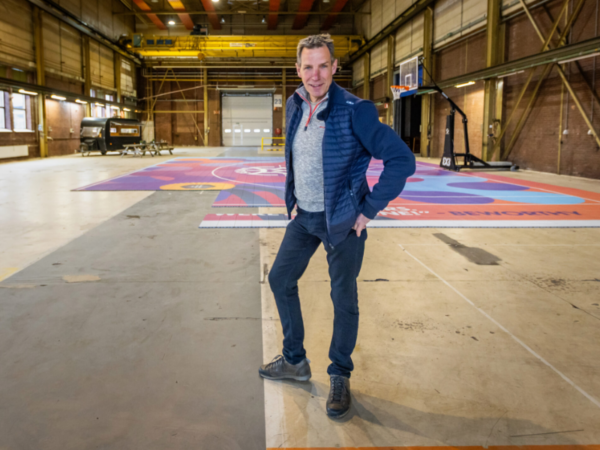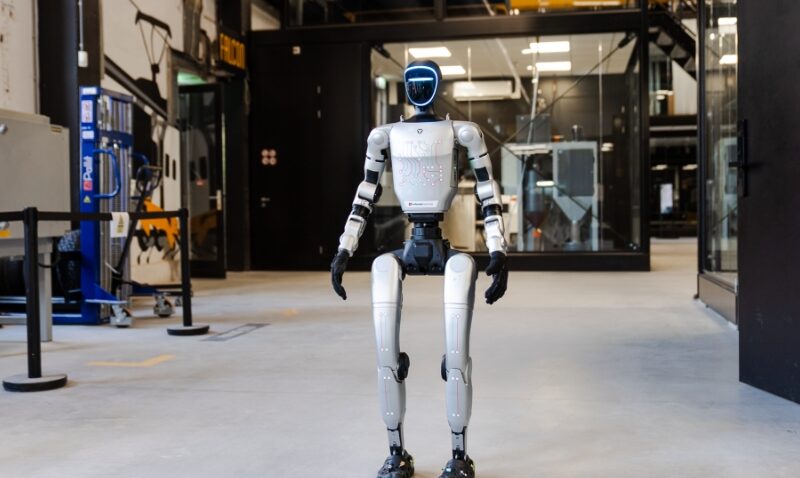
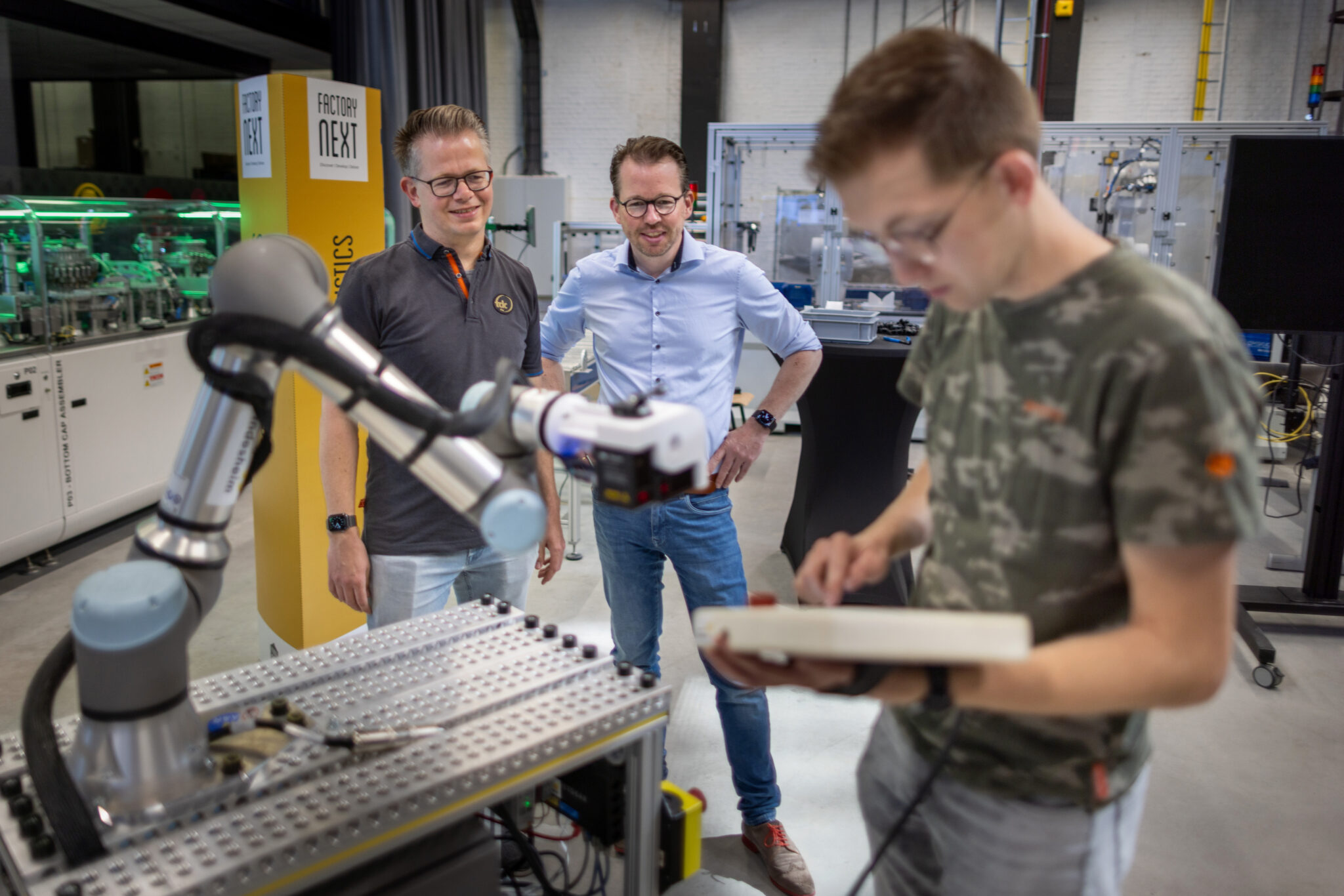
Unitree G1, or ‘Fifty’, the robot that looks like a small doll, is something you may encounter more often in the future. Peter Schuurhuis and Arend Luten are investigating together with students at Perron038 how these so-called cobots can be deployed.
“Every cobot is a robot,” says Peter. Peter is a researcher within the Digital Business & Society research group and supervises students at Perron038 as they experiment with technical innovations. Various schools, including Windesheim, and companies collaborate within Perron038. This collaboration makes it possible to try out technical innovations, and allows both students and researchers to experiment with new technological developments such as robots.
“Cobot is a combination of the words ‘cooperation’ and ‘robot,’ in other words, a collaborative robot. The major difference between the cobot and the robot lies in their motor skills: the cobot is sensitive.” This means that when a robot senses it is bumping into something or someone, it will halt its action. “A robot arm, for example, is programmed to perform an action from A to B. It is therefore unsafe to get too close to it, which is why it is often positioned behind a fence: if you stand in its path, it will push you aside or could injure you. A cobot performing the same task from A to B will stop when it detects that it is bumping into you,” says Arend. Arend works at Tembo, one of the companies with which Perron038—and thus Windesheim—collaborates. “This is due to the sensors a cobot possesses: these allow it to detect when it runs into someone and correct itself.”
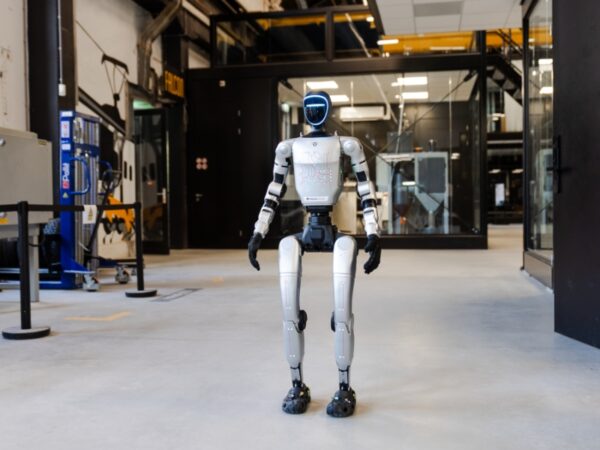
Unitree G1, or ‘Fifty’
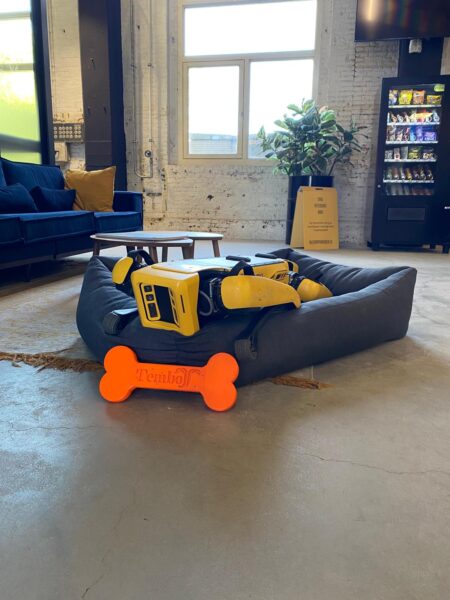
Recently, not only has the robot dog Spot been walking around at Perron038, but you can also occasionally find Unitree G1, also known as ‘Fifty’. Fifty is a so-called ‘autonomous humanoid robot’, which means he looks like a little doll of about 1.30 meters tall and can walk around independently. Due to the construction of Perron038, Fifty changes its home from time to time. For instance, he is currently at a company to be tested in practice. Both are programmed by students. “We work together with companies,” says Peter. “They purchased the robot for commercial reasons: how can it help them in a factory process? Spot, for example, is sometimes deployed when there is a potential danger to people due to gases or the risk of collapse. What could that same robot do in a factory? Students look at the companies’ needs and then experiment with functions the robot could perform. The butler function Spot had at Perron038 is one such example of a function devised by the students.”
“Students very often enjoy working on them, but soon realize that it can be disappointing. The problem is that there is no universal robot: every company develops its own robot with accompanying software. As a result, every time you receive a new robot, you first have to see how it actually works before you can try it out.”
Helpful cooperative robots
“Unitree G1 is built like a human because we realize that we need these functions. How convenient would it be if, for example, a cobot walked along with the plumber and carried the heavy tools up the stairs? Or if a cobot could just walk back to the van if you’ve just forgotten the screwdriver you need?” says Arend.
Through the research and experiments being conducted at Perron038, it is possible to examine how applicable the various robots are in these and other situations. “The most important question we are asking ourselves now is: ‘should we adapt the process to the robot, or the robot to the process?’ After all, depending on this, the factory changes from the inside out,” Peter explains. “You can imagine that when the robot moves through a factory on its own, you have to adapt the factory so that the robot can actually walk around.”
A robot is not a human
“Robot dog Spot and Unitree G1, even though they are cooperative robots, are still potentially dangerous machines,” says Peter. “They are strong, and by programming it well, we can use them. Nevertheless, it is important to remember that you are working with a machine, not a human. A programming error can turn out to be potentially dangerous.” “People are quick to humanize a robot,” says Arend. “When a robot looks like a human or a dog, we automatically attribute characteristics and feelings to it. If I push Spot during a demonstration causing it to lose its balance, people often react with: ‘That is not nice.’ While, of course, it is just a machine.” Arend and Peter therefore do not refer to the robot by its name Fifty, but call it the Unitree or the humanoid robot.
That is precisely where a challenge lies for students and companies. “A robot may look human or friendly, but the way it perceives its environment and reacts remains fundamentally different from humans. The question, therefore, is not only what a robot can do technically, but also how to properly align humans, processes, and robots. It remains a puzzle when you combine these three!”
‘Fifty lashed out’
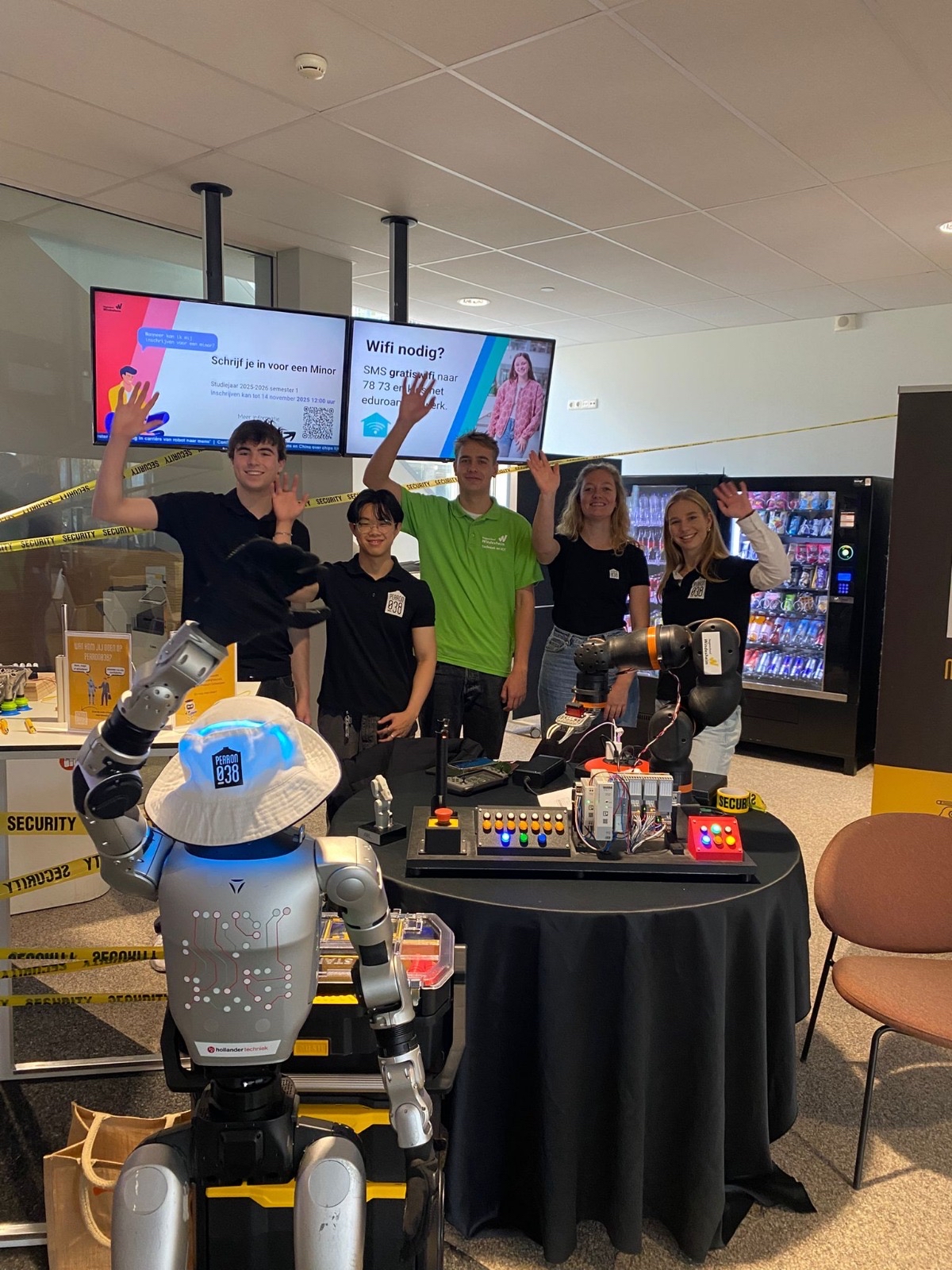
Stijn Kuijper and Jeremy Utomo, engineering students, worked with Fifty during the ‘Factory of the Future’ minor. During this minor, they set to work on programming the robot and exploring how it could be deployed. “I think working with a humanoid robot is really cool,” says Jeremy. That is why he chose this project at Perron38 during the minor. Before the students can get started with the robot, they first receive instructions on how to work with Fifty. “It is especially important that we view Fifty as a robot and not as a colleague,” says Stijn. “That is why the company chose the name Fifty: you don’t call an animal or a person fifty,” adds Jeremy. “Furthermore, they don’t speak of him or her, but rather ‘it,’ and it has an owner.”
Programming Fifty turns out to be a bigger challenge than expected: “You see a lot of videos online of robots dancing or doing a backflip. I found out that little is known about how to program these robots,” explains Stijn. “There are many humanoid robots, and they all work in different ways. As a result, it involves a lot of searching and experimenting.” Jeremy adds: “Many different disciplines come into play when programming a robot. For instance, I specialize more in the hardware behind a robot, while Stijn was more focused on the software. Luuk, the third student on our team, comes from Mechanical Engineering. In all the videos, for example, you see the robots dancing, but the hardest part isn’t making the robot dance. It is much more complicated to get a robot to pick up a bottle or do other things where the environment is also important. That is precisely when you need all that knowledge.”
“Fifty literally does what you ask of it. People sometimes use idioms to explain something. Robots don’t understand that, and that can lead to miscommunication,” says Stijn. “I made a mistake while programming. When I turned Fifty back on, it lashed out wildly. It hit me too,” says Jeremy. “That’s when you realize Fifty doesn’t have an emergency button: you can’t just turn it off.”
text: Boudicca Meerman
photo from the researchers: Herman Engbers
other photos: Students