The acceptance of gay people is declining among young people, shows a nationwide study. Do students and lecturers at Windesheim who are part of the LGBTIQ+ community themselves recognize this trend?
‘Anti-LGBTIQ+ stickers can also be found at Windesheim’
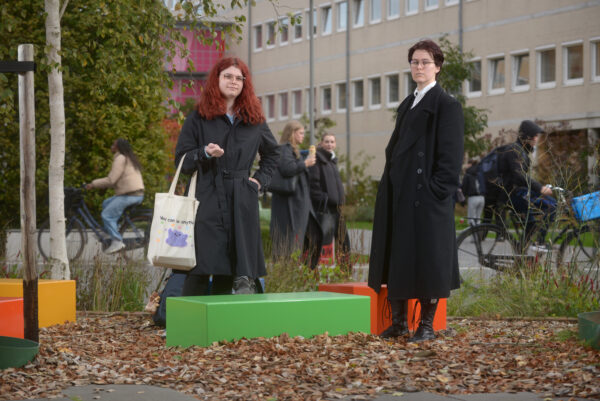
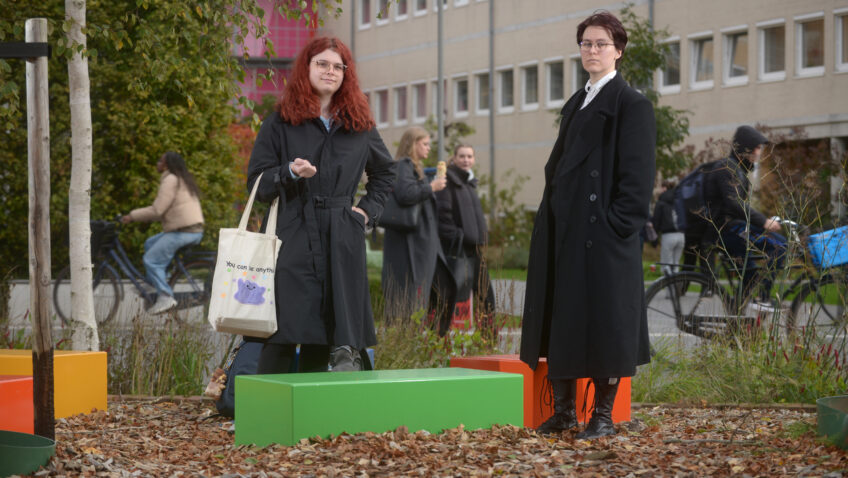
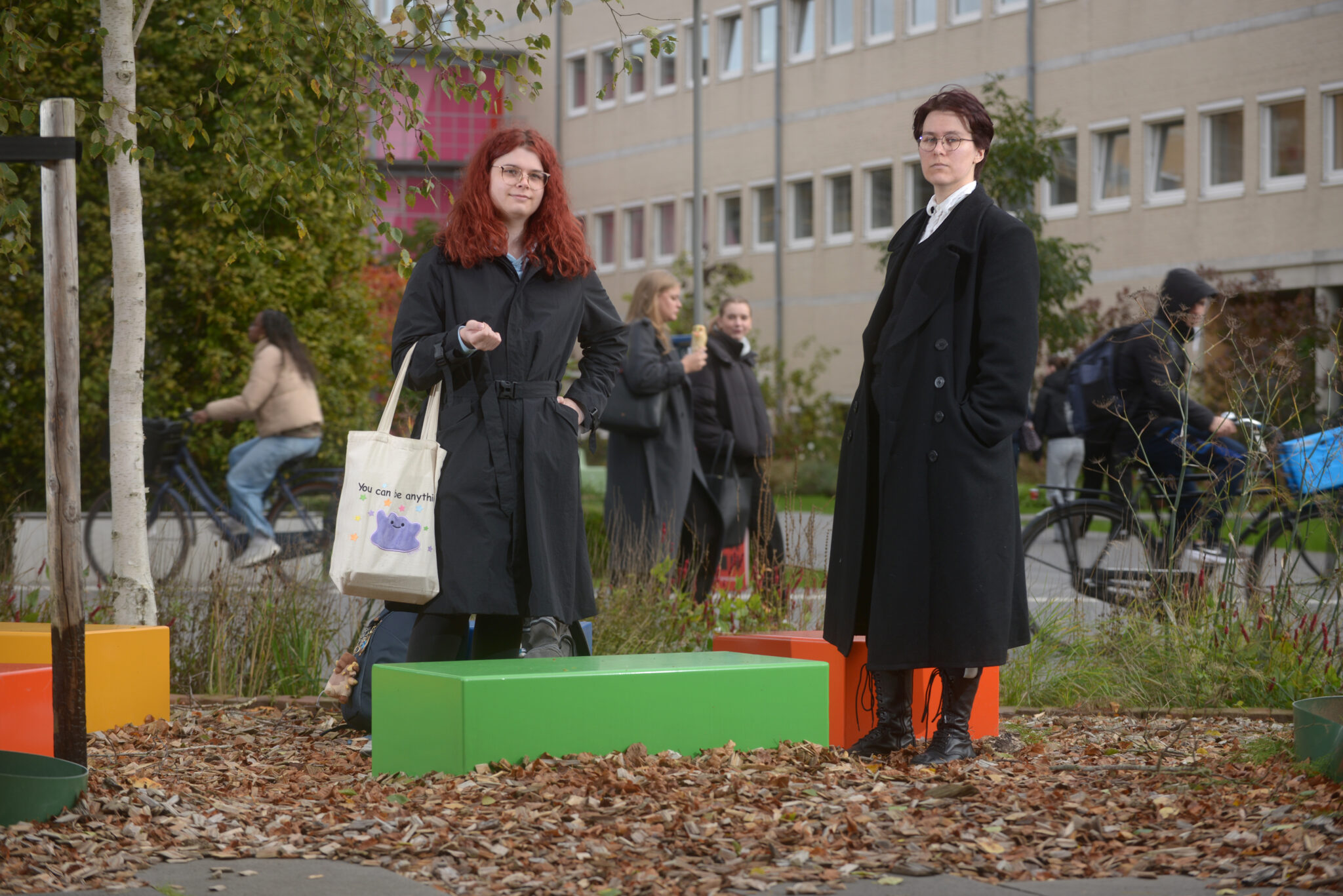
Lucy Schonewille (24) and Esper Eker (28) have been together for 2.5 years; it is their first queer relationship. “We stand out when we walk hand in hand, and that took some getting used to.”
Esper, a fourth-year student Teacher Education in Biology, notices that people sometimes stare at them. “Fortunately, we haven’t faced any obvious hostility here in Zwolle yet. When I lived in Maastricht, however, I did experience that several times, people giving me the middle finger or calling me ‘dyke’ or ‘lesbo.’ Because – back when I presented as a woman – I dressed rather punk-inspired.”
“When we walk hand in hand, I’m well aware that we stand out as a queer couple. But that doesn’t mean I avoid such behaviour,” says Lucy, a second-year student Information & Communication Technology.
In the past, Esper sometimes felt embarrassed about being queer. “I was so conscious of everything. But now, I couldn’t care less! I simply love my girlfriend, so if I want to walk hand in hand, that’s what we do.”
Unsafe
Lucy agrees with the research indicating that acceptance of the queer community is declining. “I frequently hear comments when I walk across campus. Sometimes I even see anti-LGBTQ+ stickers, in elevators or on lampposts around the campus grounds. For quite a while, there was a sticker featuring an umbrella, supposedly to ‘protect’ children from the rainbow above. It makes me feel unsafe; you never know who you can trust, or whether someone might say something hurtful the moment you reveal details about your identity.”
Esper wonders whether the acceptance of gay people among young people is declining in all aspects. “There is also a study by Rutgers and SOA Aids Nederland – ‘Sex Before 25’ – which actually shows that acceptance among young people is on the rise. I do notice that in my classroom, terms like ‘homo’ or ‘gay’ are used as insults more readily; though, in my view, the students I teach often do this just to get attention, without really understanding the implications. On the other hand, these same young people are much more open about their own sexuality. Some students, as young as fourteen, already have a very distinct personal style and are quite certain that they are lesbian or gay.”
During his high school years, Esper himself had not yet progressed very far in his process of self-discovery. “I used the label ‘asexual,’ and only began to explore my own gender more deeply when I was 20 and moved out of my parents’ home.”
Spread hate
According to Lucy, this decline in acceptance is largely due to American politicians. “In the Netherlands, positive measures are being implemented and there is attention given to the queer community. However, we also see a great deal of hate online, often on platforms centered around the U.S.
The political bullshit happening over there, where LGBTQI+ individuals are actively being targeted, is unfortunately spilling over into local politics here. The same goes for the ‘manosphere,’ which originated in America.”
Esper agrees with this. “There has been a significant rise in hate-filled content originating from the United States and the United Kingdom. AI bots are being used to deliberately provoke arguments, all to generate more clicks and, consequently, more money.
The ‘manosphere’ also has a major influence on the perceptions held by young men and boys. What does masculinity actually mean? According to the manosphere, it’s embodied by figures like Andrew Tate, someone who has ‘made it’ and dictates how a man ought to be. The message is: just try to be like him.
Then there are young people who don’t necessarily agree with these views but still make jokes about them. Escalating behaviour almost always begins with ‘just’ a joke. If you fail to set a boundary here, you’re effectively signalling that such behaviour is normal and ‘perfectly acceptable.’”
Target
For Lucy and Esper, their identity means there is a whole list of countries they can never travel to. Lucy says: “In America, the government is targeting LGBTQ+ people, classifying transgender individuals as ‘drag’ performers, and then labelling drag as ‘pornographic,’ all in an effort to ban them from public life.
If we end up with a right-wing government here, I fear that something similar could happen. That scares me more than the average person who might hold a negative view of our community. Though it is actually precisely the average person who make the rise of a right-wing government possible.”
“Homosexuality is too easily used as an umbrella term for all queer identities,” says Esper. “Every label, every identity comes with its own specific set of challenges, yet they are all lumped together as one big issue. If you display feminine traits, are perceived as cowardly, or simply don’t ‘play along’ in the expected way, you’re quickly slapped with the label ‘gay.’
In my view, hatred toward gay people or toward other identities that fall under the queer umbrella is rooted in the unstable position that young people occupy in society.”
‘I was spat in the face by teenagers’
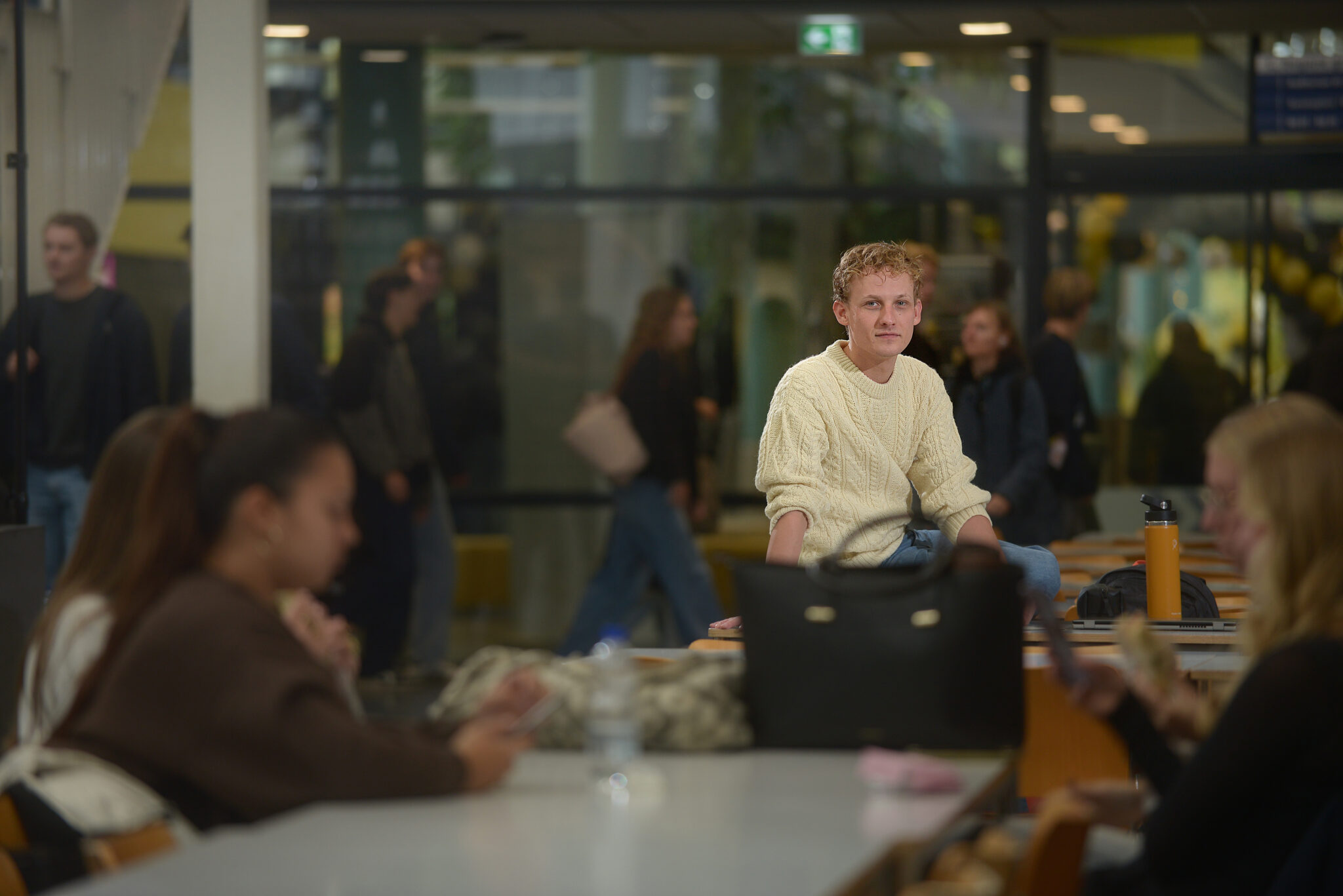
Pim Voerman (32), lecturer Teacher Education in French, concludes that there was greater acceptance of gay people fifteen years ago than there is today. This was not what he had expected.
“Fifteen years ago, when I was a teenager, there was more of a general sense of acceptance. I always assumed that things would only get better for the LGBTQ+ youth growing up at that time. I assumed that they would be able to be completely themselves in the future.
To read now that the acceptance of gay people in secondary schools – which due to social norms are never entirely safe for anyone – is declining so sharply, is truly distressing. There is a trend in society today where people feel they can say absolutely anything that’s on their mind.”
In his view, acceptance always comes in waves. “Since the 1980s, we have experienced a remarkable increase in freedom. People were more empowered to be themselves, and we assumed things would only keep getting better.
But I, too, notice that more and more negative remarks are being tossed around in public, and that the acceptance of gay people is now in decline again. I was already a bit afraid of that. In fact, I believe it goes hand in hand with the regression of women’s emancipation.”
Boys on fatbikes
Visibility for the queer community and the ability to be open about who you are, is important to Pim. That said, he does walk down the street differently these days; “Last year, I was spat in the face by three teenagers on a fatbike. I felt devastated, violated even, and I jumped straight into the shower the moment I got home.
And yet, I mostly just felt sorry for these boys, that they felt the need to do such a thing. The Netherlands likes to proclaim how tolerant and open-minded we are, and for a long time, that was certainly true. But that doesn’t always apply to people who dare to stand out from the crowd.”
According to Pim, we need to pay close attention to the negative voices. “Firstly, because this group is quite large, and secondly, because I believe they sometimes genuinely feel as though something is being taken away from them. The white, heterosexual man has long held a very comfortable position in society. Suddenly having to compete with a group that previously wasn’t even part of the ‘competition’, is bound to trigger a certain kind of fear. Fear is a poor advisor, yet it is often the root cause of this kind of crazy decline.”
Manosphere
According to Pim, there are several causes for this decline, including the influence of religion, rising conservatism, social media, and polarization within the broader political discourse.
One such factor is the rise of the ‘manosphere’, a collective term for online platforms and social media channels centered around masculinity, gender roles, and critiques of feminism.
“In my view, the manosphere consists of a large group of fearful men who are trying, with all their might, to suppress their emotions. Since the 1970s, girls have been told that they can become anything they want to be. I believe we’ve forgotten to include boys in that conversation. They simultaneously should have been taught that it’s okay to feel sad and to show it. I still often hear young parents telling their crying sons to ‘be tough,’ while girls are comforted.”
Pim adds: “If, as a society, we teach boys that they are allowed to be who they are, everyone wins. We wouldn’t end up with repressed, anxious men. Right now, it seems as though society views ‘feminine’ traits as inferior; a caring man is dismissed as a ‘sissy,’ while a woman who’s handy with tools is considered ‘tough.’ What does the phrase ‘man up’ actually mean? In my opinion, expressions like that only serve to suppress a person’s self-expression and the development of their identity.”
‘I was scared of the opinions of others’
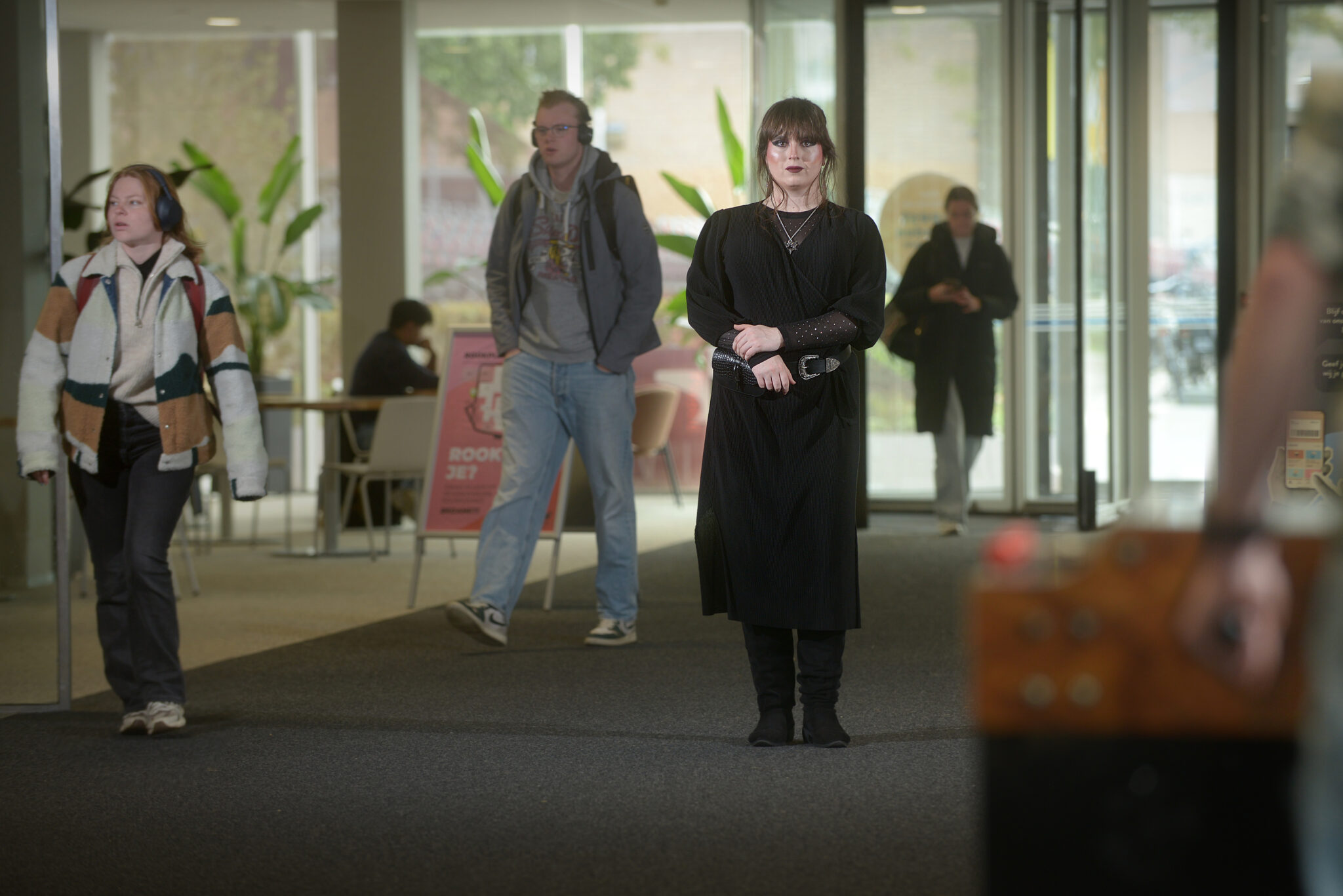
Nora Folkers (25) is a first-year Social Work student. She makes a conscious choice not to tell everyone that she is a trans woman. ‘A lack of acceptance stems from a lack of understanding.’
When Nora began her studies this year, she didn’t want to keep the fact that she is a trans woman a secret. “In principle, anyone studying social work should be willing to work with any human being. But I don’t tell just anyone. I did eventually tell my classmates that I was assigned male at birth. They didn’t make a big deal out of it; in fact, they appreciated that I chose to share it with them.”
According to Nora, fewer and fewer young people feel comfortable coming out. “Back when I was in high school, there was a lot of focus on initiatives like ‘Purple Friday’. Back then, you weren’t as likely to be verbally abused for simply being who you are.”
I believe this decline in acceptance among young people stems from a lack of understanding. When people encounter something they aren’t familiar with, something they’ve never seen before, it’s almost human nature to develop a sense of fear. You want to protect yourself from the unknown, which often leads to a distorted perception. ‘What do you mean, born in the wrong body? Or in love with someone of the same sex? Isn’t that just… strange?’ That is, until you actually speak to the person and begin to understand things better.”
Gap of misunderstanding
Back when Nora was still experimenting, she was primarily scared of what others might think. “The first time I started dressing in a more feminine way, I was absolutely terrified. I was afraid that people would stare at me, or that someone might try to harm me. I’d seen things on the news. These weren’t just imaginary fears.
Some people seem to think that I’ve chosen to feel this way, much like the idea that gay men supposedly ‘choose’ to be gay. I once heard someone say, ‘I don’t want a gay friend, because then I might end up becoming one myself.’ That reveals a massive gap of misunderstanding.”
According to Nora, it is important that education begins with children. “They need to learn that there is more to the world than just heterosexuality, or the categories of ‘man’ and ‘woman.’ If parents hold negative views about people like us, those views are instilled in their children from a very young age. Therefore, education on sexuality and gender identity needs to be introduced in an accessible way, starting in primary school.”
Nora is certain that there will always be people who refuse to show any understanding. “There are parents who, when sex education is provided in primary school, report their child as sick to keep them home. Therefore, it needs to be explained to those who are open to it, in the hope that they will, in turn, inform the people around them, allowing the information to filter through in that way.”
Walking encyclopaedia
Sometimes Nora is asked why she is trans. She feels it is her part to provide an answer calmly and patiently. “Some people simply don’t understand it at all. Sometimes I feel like a walking encyclopaedia, because they could have easily looked up some of these answers themselves. But if someone is genuinely interested, I’m happy to explain and I hope they’ll go on to share what they’ve learned with their own family or friends.”
Nora is aware that this process of explaining things also has a downside. “I frequently hear people say that homosexuality receives far too much attention. Many people express this view, and I believe that, even when a conflict reaches its absolute peak, it will eventually subside, and opinions will begin to meet. The hope is that, on both sides, there will be a return to greater mutual understanding. But with so many millions of people and so many different opinions, reaching that point is difficult, and that’s just within our own country.”
‘On the train, they pushed me back and forth’
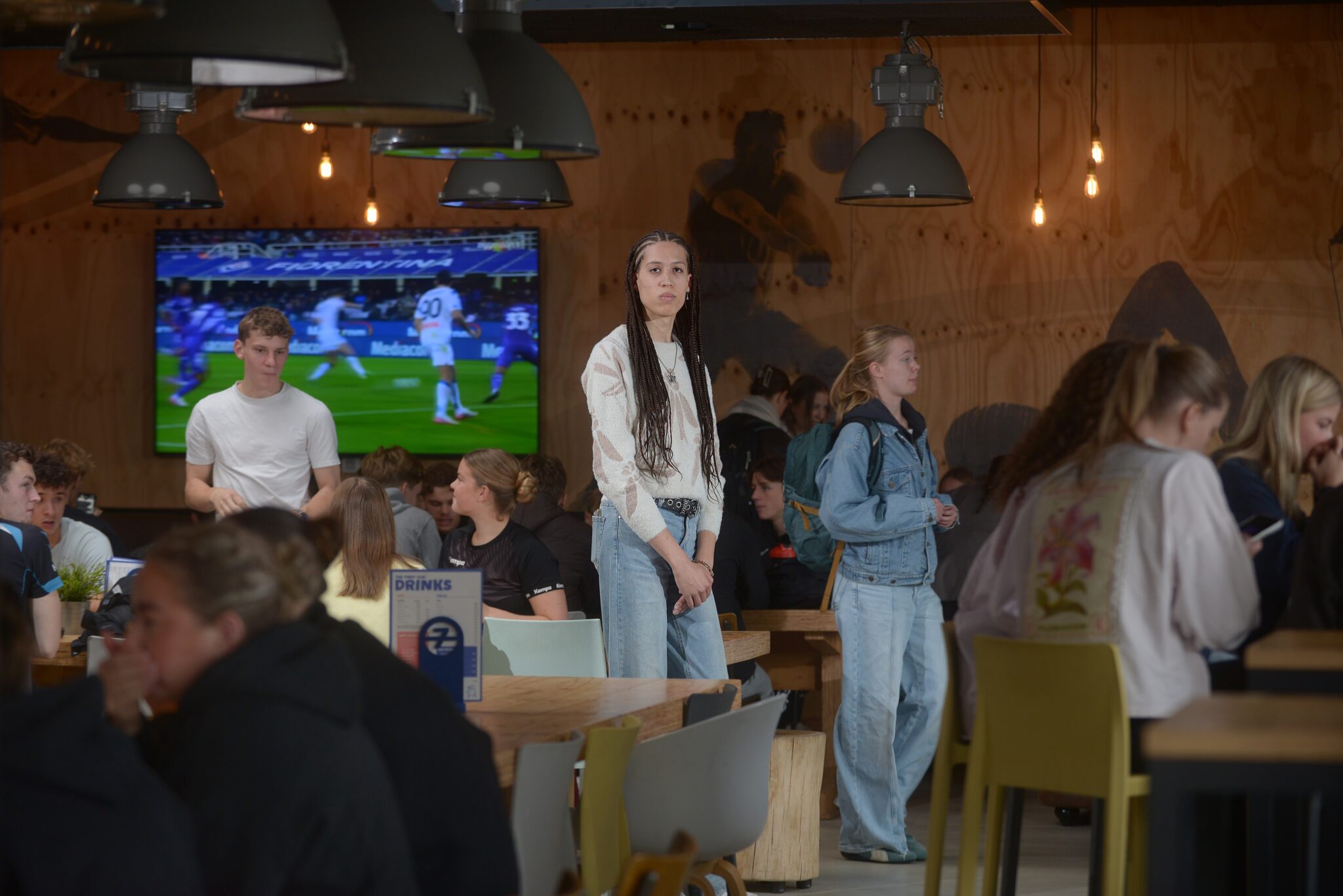
Zoë Diderich (24), a fourth-year student Information & Communication Technology, takes a bleak view of the future for the queer community. “I try to stay away from places where there are a lot of drunk people.”
Zoë was 18 years old when she first told her parents that she is a trans woman. “I had known for much longer, but I noticed that the people around me found it difficult to accept. During my childhood, comments were made about trans people that made me feel unsafe. By now, the people around me have reached a point where they accept my identity, but some still find my medical transition challenging.”
Zoë confirms the suggestion that there is less acceptance of gay people among young people. It is something the ICT student has been noticing for a long time. “I often hear people say that the queer community is being ‘shoved down their throats.’ But when I dig a little deeper, it always comes back to what they see on social media. And those aren’t queer people, they’re influencers like Andrew Tate, who say; ‘Look how bad this is.’ It’s only a small group that’s driving the discourse around the queer community on social media, and it’s all negative.
In this day and age, where young people are often raised more by social media than by their own parents, they can develop a distorted worldview.”
Too dangerous
Zoë herself is being called out to on the street more often than in the past. “Especially when I’m alone, but also when I’m walking hand in hand with my girlfriend. It happens an absurd amount. On our first date, we went out for dinner, followed by a walk through the city. That evening, people called out to us no fewer than five times. Usually, it doesn’t affect me much, but the fact that it happens even when I’m on a date really gets to me.”
Especially in places where there are many drunk people, Zoë tries to stay away from others. “Closing time at a club? Too dangerous!
But even on an evening when I had to take the train from Zwolle to Emmen, and found myself in a compartment with a group of farm boys, I didn’t feel safe. They were shouting, shoving me back and forth, and messing with me. I was on a train, a train I needed to take to get home. How could I have avoided this situation?”
Purple Friday
The level of acceptance of gay people within technical study programmes at Windesheim is something the student has always found problematic. “In my programme, on one hand, the students are super progressive, while on the other, there are those who are completely unaccepting and lean strongly in the opposite direction. And the lecturers, they do very little to address it.”
For instance, while preparing for Purple Friday, Zoë handed out wristbands. “It was a good opportunity to see how people view the queer community. In the T-building, the students were very open, but about 70 percent of the lecturers didn’t want to wear a wristband. In the X-building, however, the lecturers were very keen to take part, while it was the students there who threw insults at us.”
Emigrate
She views the future rather bleakly. “In the Netherlands, there’s a culture where everyone feels the need to have an opinion or say something about everything, which makes living here unpleasant. I’m two meters tall. Even once my transition is complete, people will still make comments about the fact that I’ve transitioned.
I’ve been planning to move to Spain for quite some time. They’ve shot to the top in Europe when it comes to acceptance, both legally and socially. Why is that? In my view, it’s because young people there make very little use of English-spoken social media.”
text: Michelle van der Molen
photos: Jasper van Overbeek