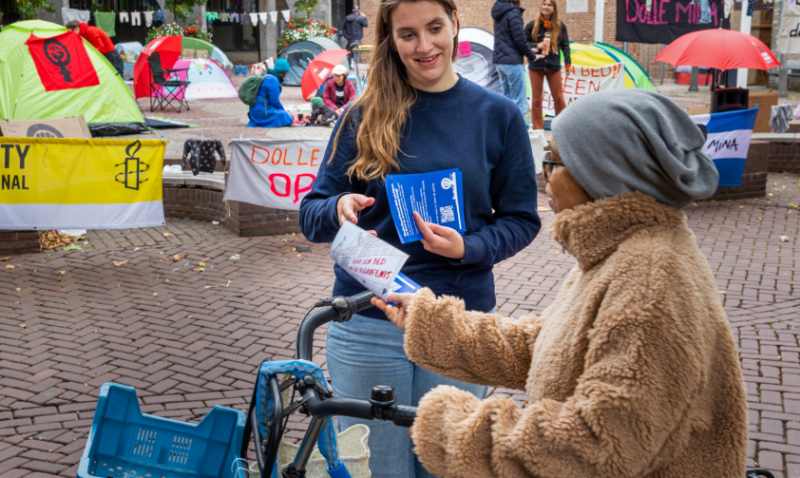
Student Laura van de Scheur often takes to the streets with the Dolle Mina activist group. Because things need to change, she believes. “There’s too little attention paid to women’s issues in politics.”
When Laura, a first-year Teacher Education in Biology student, heard that a Dolle Mina group was being established in Zwolle, she signed up. “Everyone knows the protests from the past, from the 1970s: burning bras, occupying urinal sites, and women’s rights to pregnancy. But today, it seems just as urgent, and that’s why I joined.”
Because according to 27-year-old Laura, attention to women’s issues has decreased again in recent years. “In politics, women’s issues are structurally neglected. Yes, femicide is getting a lot of attention right now, due to a number of major cases that happened one after the other. But the fact that there are, for example, few shelters for women experiencing domestic violence, or that they still consistently earn less than men—that’s what receives little attention.”
Inclusivity
Laura also finds inclusivity very important. “Actively working for the rights of all minorities. For example, lesbians are still seen as sex objects, there are too few inclusive restrooms, and people demonstrate against Pride Walks.”
The action Laura remembers most? That’s the Pride Walk in Kampen, where Dolle Mina participated as a “buffer” because Christian groups had announced a counter-demonstration. “So we were the first to hear the hateful comments. It’s a shame that people don’t give others the freedom to be themselves. I’m bisexual myself, and people say things to me that make me think, ‘Does your mother know you’re saying that?’ People I know in Ommen really don’t dare walk down the street holding hands either.”
Online activism
The Zwolle group (which also calls itself Zwolle Mina) is active in a large part of Overijssel. Besides many physical activities, such as demonstrations, the Dolle Mina’s are also very active online. “I provide content for social media, for example, distribute messages, and contribute ideas for things like ‘what do our stickers look like?’ It’s quite broad, and you can always join in with whatever you have time for.”
It’s also very helpful that the student works as a shadow council member in the municipality of Hardenberg. “I have some legal expertise, so when they have municipal questions, they often come to me for answers. Around the time of the House of Representatives elections, I researched all the programs. Which women’s issues are important to us? What could we post about on social media? There are currently 133 members in our group, but there’s always room for more. Everyone has their own expertise.”
‘Left-wing snowflake’
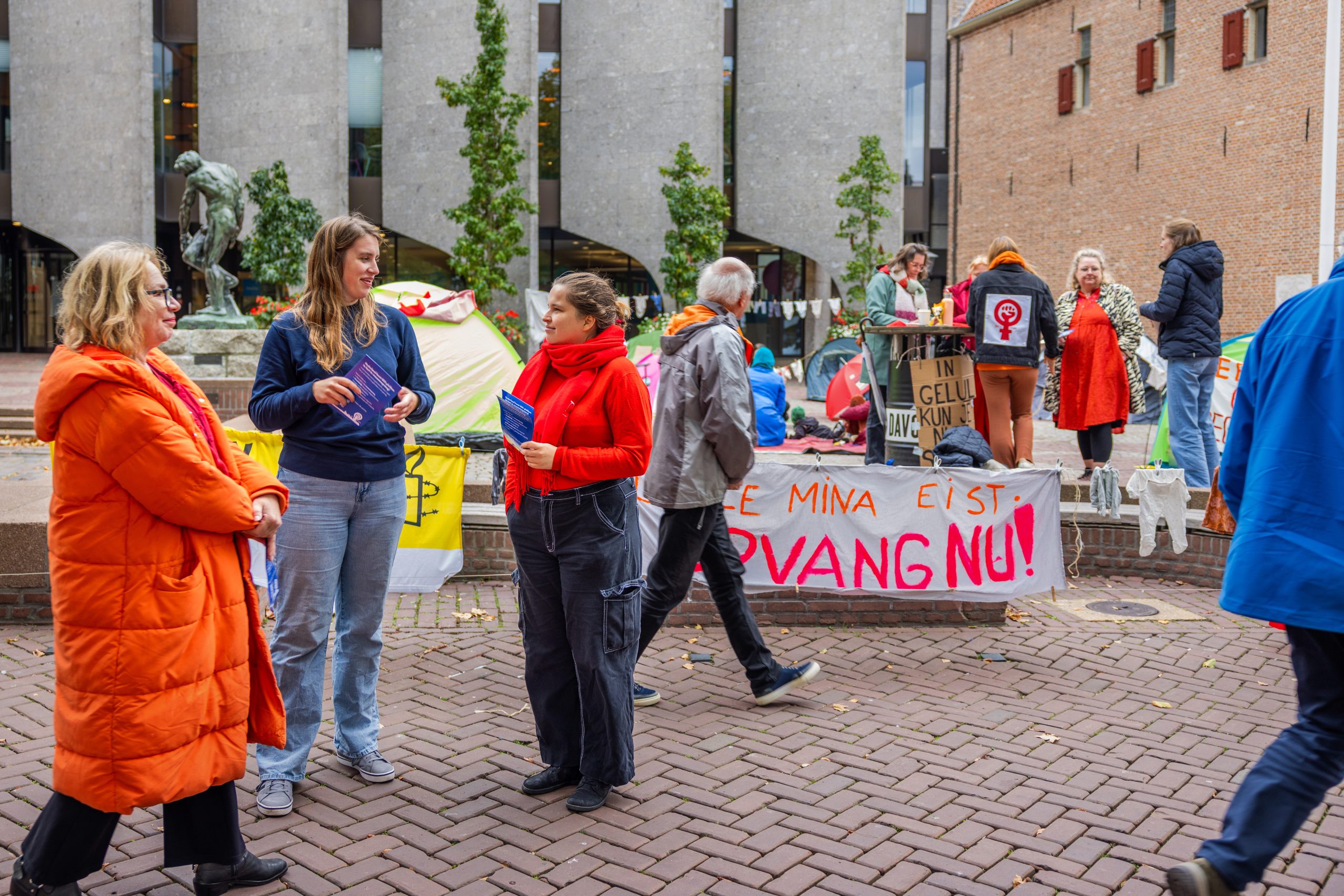
Laura didn’t have a political upbringing. “It wasn’t really a ’thing’ in our family. My parents voted, that was it. In high school, I was sent to a debate competition to improve my social studies grades. I turned out to be so good at it that I kept going to these school debates for years.”
Laura’s enthusiasm for debating gradually led her into politics, starting with the Zwolle youth council. “Then I ended up on the provincial board of GroenLinks, and from there I moved on to the Hardenberg faction. At seventeen, during my very first flyer campaign, someone insulted me for the first time. Someone then said to me: “This happens. It’s not nice, but try to ignore it. It took me a few years before I could do that.”
At Dolle Mina, the activists are each other’s safety net. “We always talk about it afterward. In politics, you get training to deal with hate, something that doesn’t happen as much at an activist organization like Dolle Mina. So I try to share what I’ve learned over the past few years with the group. If I cycle home in a Zwolle Mina shirt, people shout ‘left-wing snowflake!’ I always try to remember that it’s not about me, but about the organization I represent, which they apparently have a problem with. That’s something I teach the others as well.”
Thinking about choices
Despite her busy schedule, Laura’s studies always come first. “I’m very strict about that, and that’s not always pleasant. As a shadow council member, I have the luxury of choosing the topics I want to cover; with Dolle Mina’s, I see if the event fits into my schedule. With everything I do, I consciously think: does this fit, or should I let it go?”
I think my studies align well with my own interests. As a teacher, you’re neutral. But I do believe you can engage in discussions with your students about difficult topics. They’re often smarter than they think. I want to become the kind of teacher who encourages students to reflect on their own choices, when the topic is appropriate. Just like my friends, who thought Dolle Mina’s was a thing of the 70s. When there aren’t many minorities in your circle, you get a completely different perspective. Until I explain it, and they also understand that the organization is still very much needed.
Who is Dolle Mina?
- In the 1970s, members of this feminist activist group first took to the streets. They protested, for example, against the lack of public restrooms for women and in favor of abortion rights, using the well-known slogan “boss of own belly.”
- The name comes from Wilhelmina Drucker, a socialist feminist from the first feminist wave (from about 1880 to 1925), whose nickname was ‘Iron Mina’.
- Since the beginning of this year, the action group has made a full-blown comeback. Older activists from the early days are now fighting alongside a new generation of women.
text: Michelle van der Molen
photos: Herman Engbers
