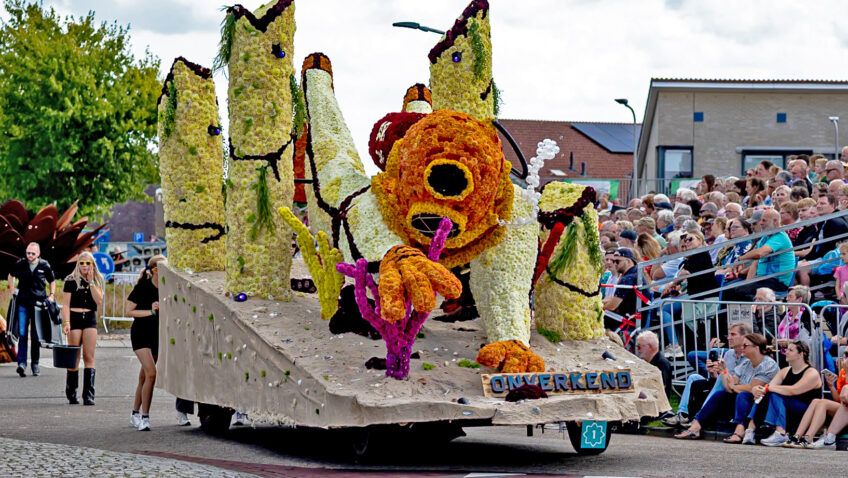
Students Irene and Tom grew up with flower parades. Every year, she helps build a float in Sint Jansklooster, while he does the same in Vollenhove. “If you live here, you have only one dream: to win the parade.”
‘Butterflies in your stomach, goosebumps on your arms’
Every year, student Irene Bovendeur (26) helps build floats with the Olympia float-building group in Sintjansklooster. “It’s more than just a float; it’s the entire process.”
Sintjansklooster. “It’s more than just a float; it’s the whole process.” As you walk onto the construction site, just behind the car dealership, you nearly trip over small children sketching the parade float. On scaffolding towering meters high, people are hard at work with tape, newspaper, and dahlias. Irene, student Teaching Certificate for Vocational Education (Deeltijdopleiding Pedagogisch Didactisch Getuigschrift), puts her hands on her hips and nods toward the gigantic structure inside the tent: “This is going to be the float this year!”
The start of the construction process
The Sintjansklooster flower parade is one of the year’s highlights. In mid-August, gigantic floats adorned with flowers, specifically dahlias, make their way through the village at a walking pace. Crowds line the streets to admire the floats. Several of these parades, including those in Vollenhove and Sintjansklooster, are now recognized as Intangible World Heritage. Known as ‘dahlia giants,’ each year the floats are constructed with care by various building teams. As you drive towards Sintjansklooster, signs of the parade are visible throughout the village: towering white tents where the floats are built, fields where the teams cultivate their flowers, and displays showing the date of the parade.
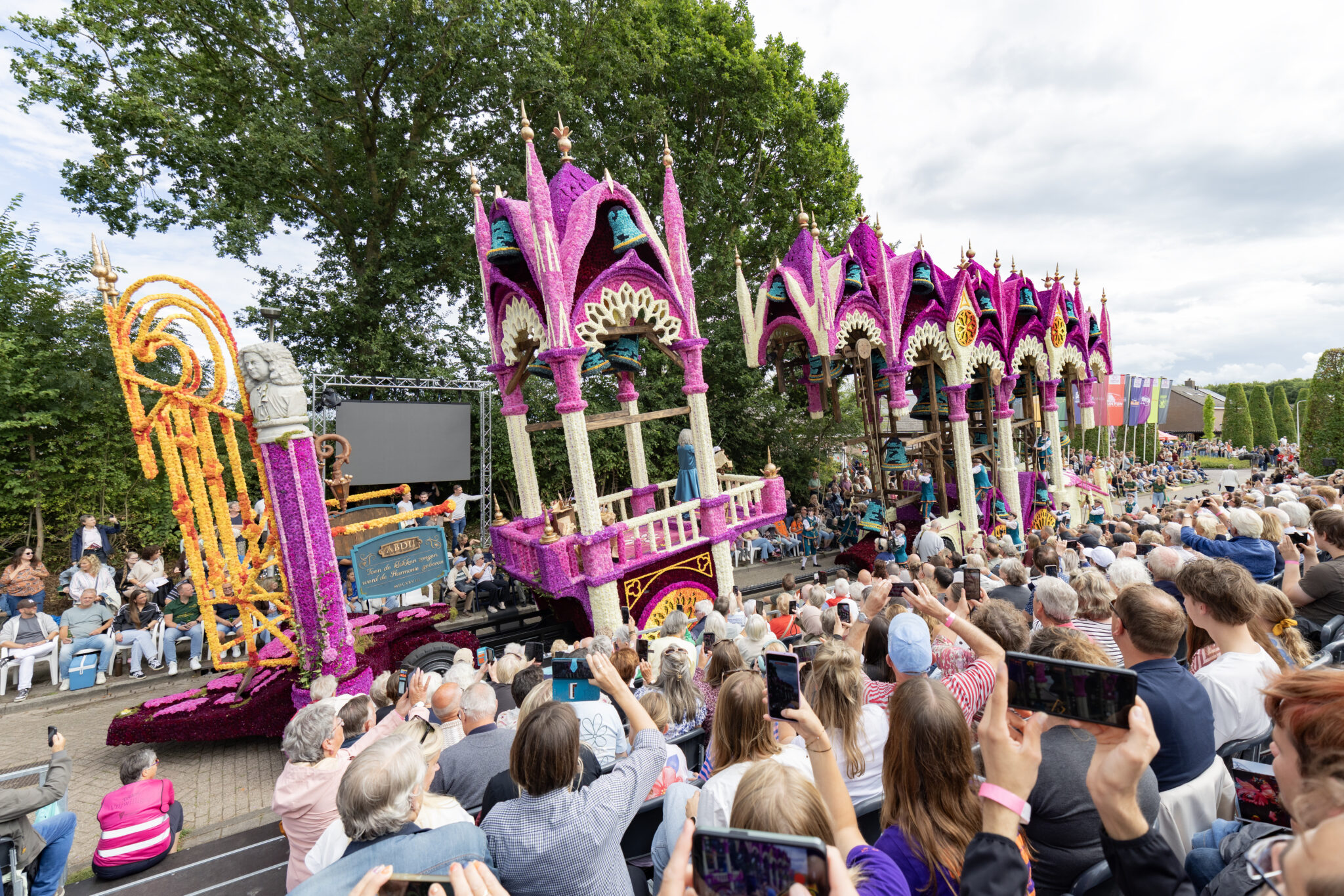
This year, Irene’s building group has opted for a structure featuring towering purple church towers as the main attraction. The tiny scale model stands at the front of the construction site so the builders know exactly what the finished structure should look like.
After a design has been selected with great care and attention and the construction drawings are ready, the actual building work begins in May.
Even though a blueprint is already in place, there are still plenty of additions: “People often have more ideas, like how to make things move on the float, or whether the framework might be better constructed a different way. Then we weld the structure.” When asked where she learned this skill, Irene laughs: “Everyone here knows how to weld. It’s just something you learn when you build floats.”
The last week
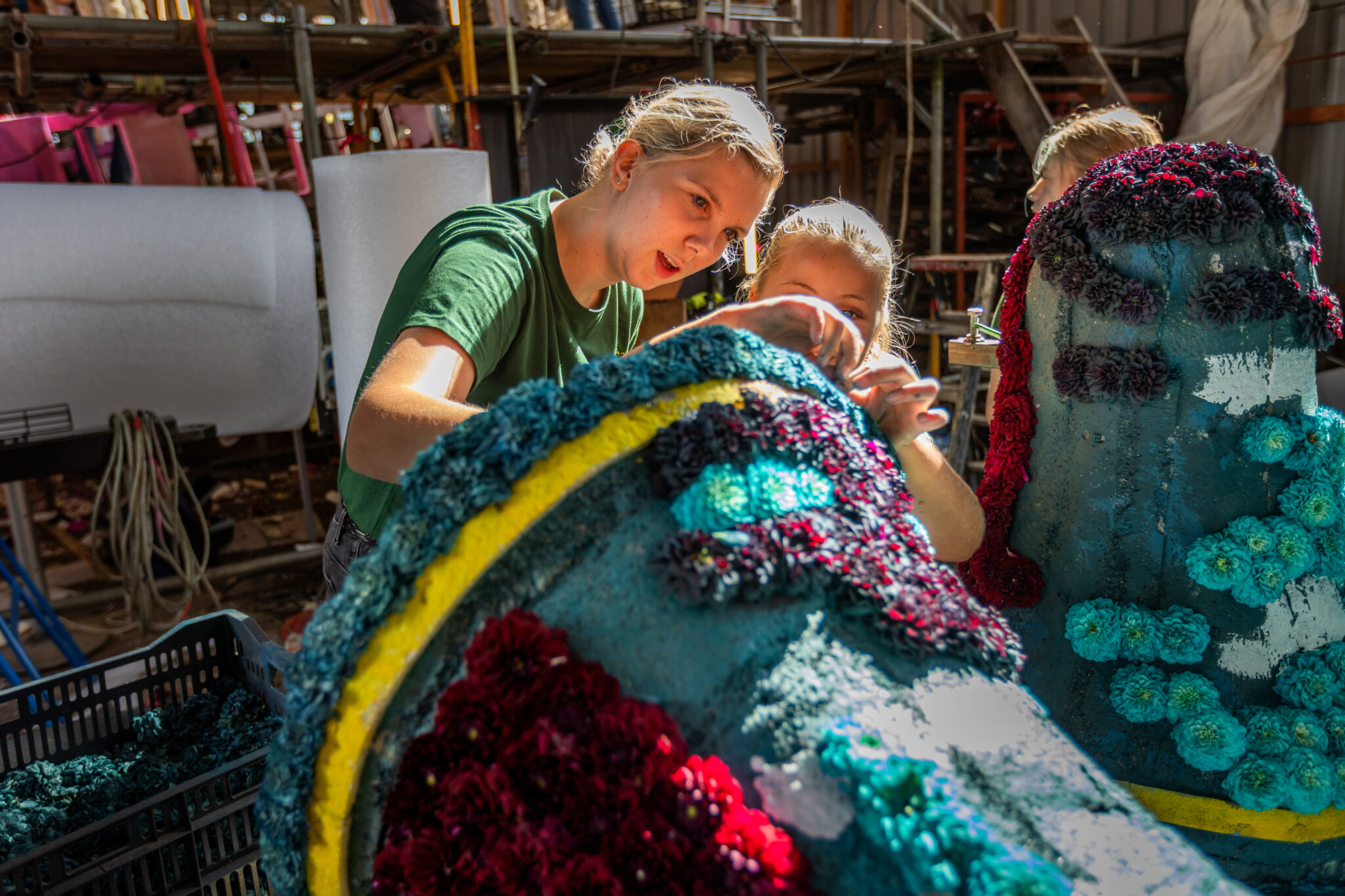
It has been all hands on deck these past few weeks, as is evident at the construction site right now. People are looking for tape and newspapers, and climbing up and down the scaffolding. The cardboard that has been attached is painted before the flowers are pinned onto it; that way, if any flowers happen to fall off during the parade, it won’t be quite as noticeable.
“During the summer, I spend all my time at the construction site or working on the parade float. This year, I’m also coordinating the performers.” These performers bring the float to life: they walk alongside it or ride on it during the parade, completing the story. “We always rehearse without the float; the performers can only practice with the actual float at the very last moment, once it’s finished.”
“The time just before the parade is always the most intense. Since you can’t start attaching the dahlias too early or they won’t hold up the work has to be done during the final week. The night before the parade is the ‘pinning night,’ when everyone pitches in to get the float fully covered as quickly as possible. I’ve pulled all-nighters myself just to get the float finished.”
Grand ambitions
“We build to reach the top,” says Irene. “My parents, sister, and younger brother belong to a different building group, one that builds simply because they enjoy it. The people there were also a bit older than me when I first started getting seriously involved. The group I’m in now included some friends of mine, so I made the switch.” This means Irene is effectively building ‘against’ her parents, but it is a matter of healthy competition: “Ultimately, we all just want a great parade. I’ve even helped another group with the flower-pinning once or twice, because otherwise their float wouldn’t have been finished on time. It’s a whole-village effort.”
“I’ve already been on vacation to beat the crowds, but I won’t be going away in the summer. I’ll be here then. I’ve never known it any other way: this is such an integral part of Sintjansklooster that you simply have to be here. When you live here, you have just one dream: winning the parade!”
Butterflies and goosebumps
“My favorite float was the one from two years ago. That was ‘Greedy’, a float featuring vultures perched atop a treasure hoard. We had worked through the night, and it was a real nail-biter whether we’d get it finished in time.” By morning—after a night of intense, non-stop work—the float was ready, and what a sight it was! “I stood there in tears as it rolled out. ‘Why are you crying?’ someone asked. I replied, ‘I’m so tired, but it’s so beautiful!’”
“You don’t really see the float for the first time until Friday morning, when the scaffolding is dismantled and it rolls out of the tent. Before that, you only see it inside the tent, with so much else in the way. The performers join in at the assembly area where you drive for the parade. That is such a special moment—that’s when you get butterflies in your stomach and goosebumps on your arms.”
‘Tribute to my little brother’
Tom Davids, a second-year student in the Associate Degree programme in Sport, was already helping to build a parade float when he was just a six-year-old boy. Following the death of his younger brother in March, this year’s flower parade holds special significance.
“Do you not belong if you aren’t a member of a parade float group? You certainly miss out on a whole lot.” Tom, 19, has been actively involved in the parade in his hometown of Vollenhove for as long as he can remember. His father moved to the small town in Overijssel a long time ago and wanted to fit in. “So, he joined a float-building group. That’s how he got to know a lot of people.”
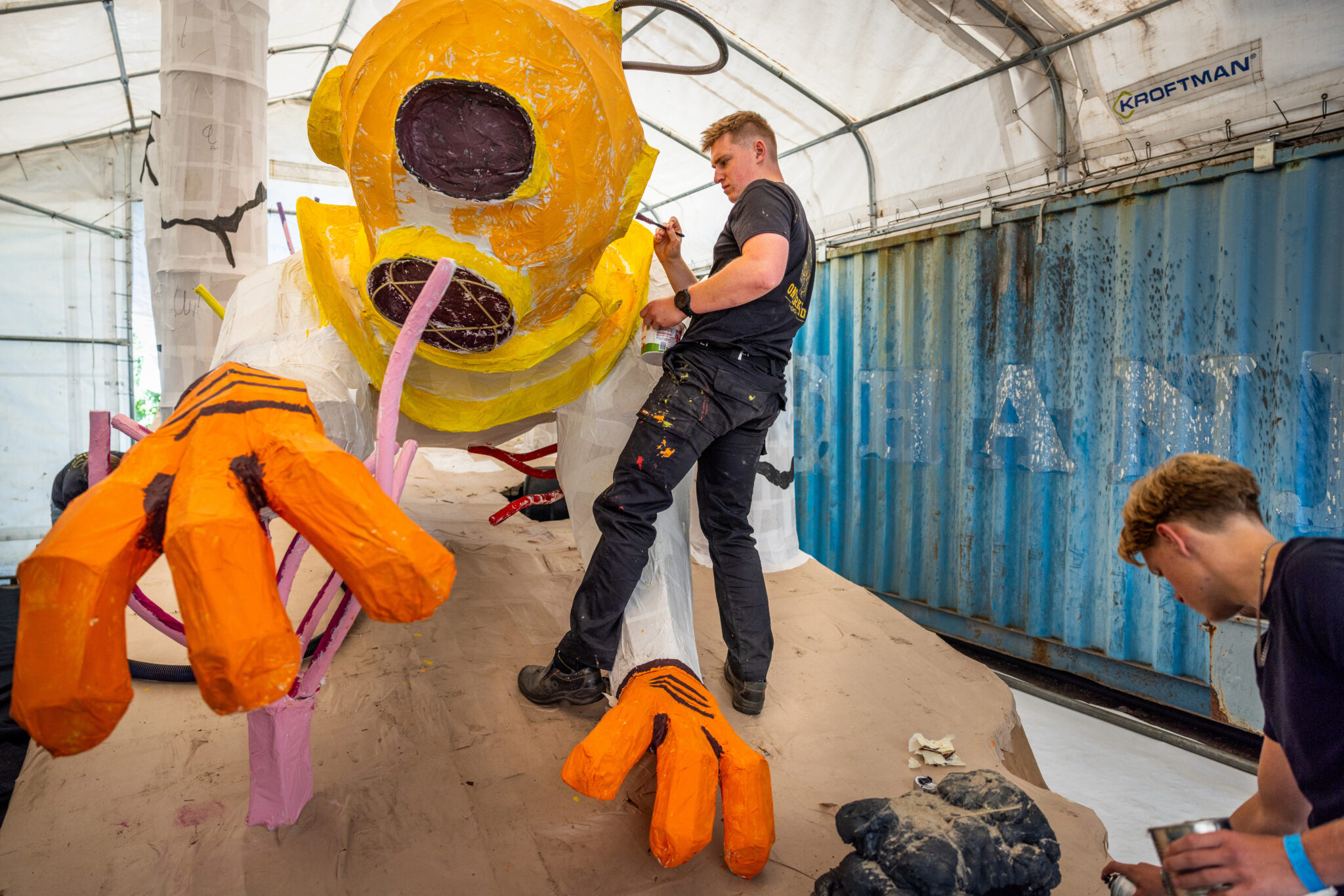
The final week leading up to the parade, when the steel tubular frame and the papier-mâché-like exterior are finished and the dahlias arrive, is perhaps the most beautiful week of the year.
Tom is part of Nameless, a group where the focus is primarily on the friendship and the fun of building a beautiful float together. “We took first place in 2024, which was really great, but we finished ninth last year and we were perfectly happy with that, too. We still had a really fun and enjoyable end-of-season party together.”
Romeo & Juliet
Many of his friends belong to the same group. “But my girlfriend is with Stark Wark. Does that make us a sort of Romeo and Juliet? Not really; it’s not a big deal, having a girlfriend in a different group works out fine.” They didn’t meet through the parade. “That just happened at the bar. She was already in a group, though. Generally, the group you join is determined by the one you get drawn into through your parents.” “If we ever have children, that might become a bit of an issue, actually,” Tom says with a laugh. “Of course, I’d prefer them to join Nameless, but they’re free to choose for themselves. Or maybe we could take turns: the first child with Nameless, the second with Stark Wark, and so on. We’d have to have an even number of children, though. But those are problems for the future.”
Rivalry
There is, therefore, a healthy rivalry between the various groups. But the rivalry is even fiercer between Vollenhove and Sint Jansklooster, the village five kilometers away that also holds an annual parade. ‘Klooster,’ as the village is known, holds its event on the third Friday of August, whereas Veno (as Vollenhove is popularly called) always holds its parade on the last Friday.
Tom: “They claim to be the largest illuminated flower parade in the world. And they do have one more float than Vollenhove this year, so that part is true, but in our parade, music groups walk alongside the floats. That’s why I think our parade is more beautiful.”
Tribute
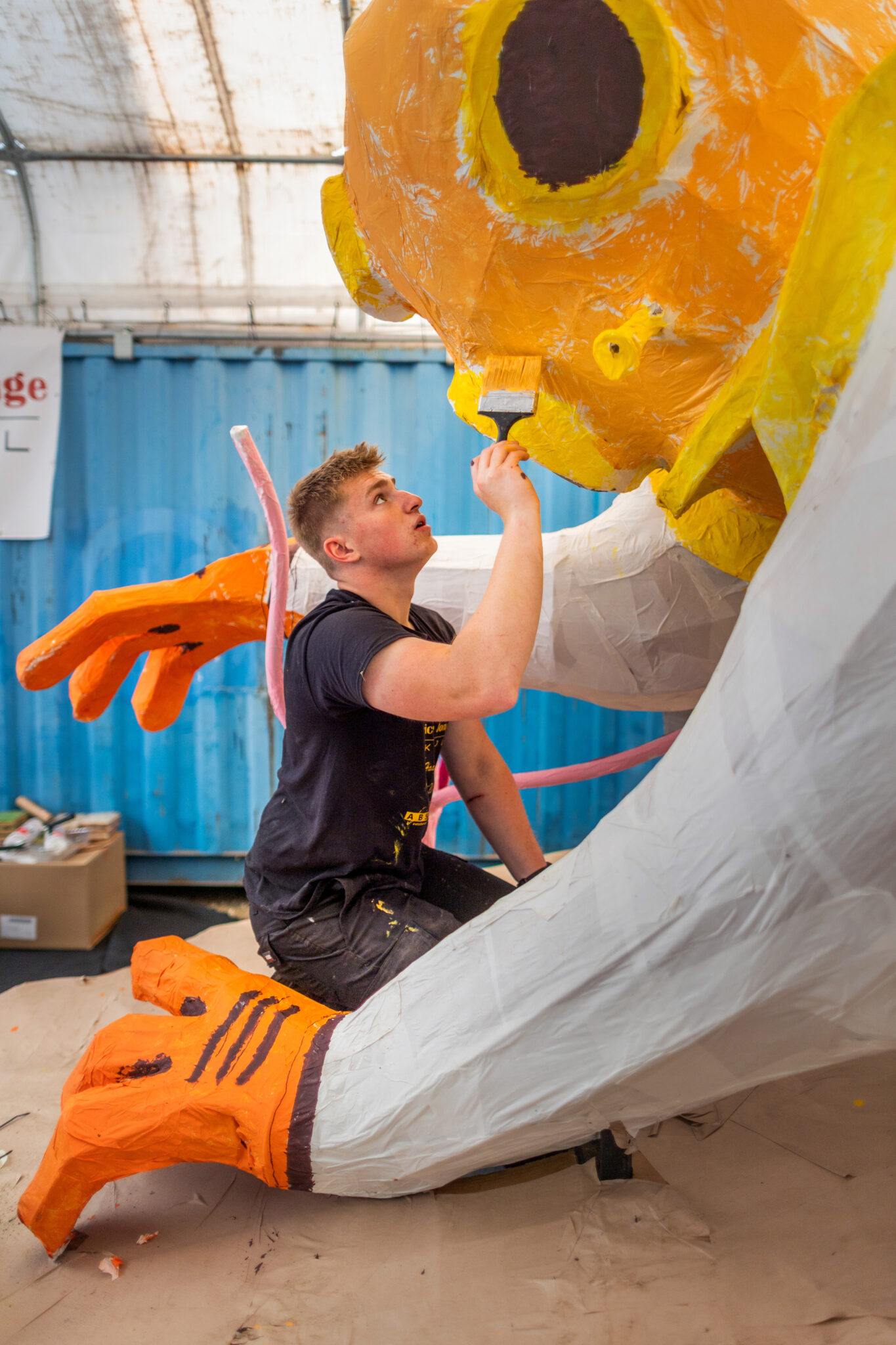
This year Tom helped build the youth float of his construction group Nameless. The design of the float, a deep-sea diver in search of the unexplored, was created by his younger brother, who died suddenly of cardiac arrest earlier this year at the age of sixteen.
“He created various designs in the past; this one was the most fully developed. As a tribute to him, we chose his design for this year’s float. It is wonderful that I was able to work on it.”
Friends of his younger brother came to help attach the flowers to the float during the final days before the parade. “They came to help pin flowers for a few hours, even though some of them belong to a different construction team and were therefore very busy with their own float. A lot of people from his school came to help out, too. It was really special.”
Tom’s float won in the ‘aspirants’ category, which includes floats built by creators up to the age of eighteen. “I drove the float during the parade through the streets of Vollenhove. That was a very special experience; it was wonderful to have that opportunity, and I felt truly honored.”
text: Boudicca Meerman, Wouter van Emst
photos Irene and Tom: Herman Engers
